

SERVICES
OUR SERVICES
We offer a full range of chemical analysis, laboratory consulting, and product support designed to help your business maintain accuracy, efficiency, and compliance. Our expert team uses advanced methods and modern equipment to deliver reliable results you can trust.

VOLUMETRIC TITRATION
Used for analyzing highly concentrated process chemical solutions, usually in large volume tanks. Involves acid-base titration, oxidizers/reducing agents, and analysis of metal cations and anions like chlorides and nitrates. A chemical sample of unknown potency is reacted against a known chemical, with results calculated using empirical mathematics and linear algebraic adjustments.


INSTRUMENTAL ANALYSIS
Includes pH, Oxidation-Reduction Potential (ORP), Ion Specific Electrodes, mV, Total Dissolved Solids (TDS), and other quick analytical procedures with handheld meters. Provides rapid, non-destructive analysis outside a lab setting, and instruments are calibrated against known standards and advanced methods like AAS and MS.

INDUCTIVELY COUPLED PLASMA MASS SPECTROSCOPY (ICP-MS)
Measures elemental composition at very low concentrations (ppb or ppt range). Uses argon plasma to convert samples into ions, which are analyzed by a mass spectrometer. Applications include environmental monitoring, clinical research, geochemistry, and pharmaceutical analysis.

GRAVIMETRIC ANALYSIS
Quantitative analysis for materials that can’t be titrated. Measures samples by weighing before and after moisture removal, or by converting the analyte into a known compound. Common methods include precipitating the analyte, separating, drying, and weighing to calculate concentration.
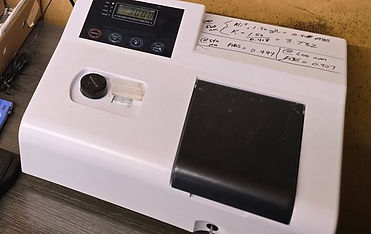

X-RAY FLUORESCENCE SPECTROSCOPY (XRF)
X-Ray Fluorescence Spectroscopy (XRF) is a non-destructive method to determine elemental composition. Primary X-rays cause atoms to emit fluorescent X-rays, which reveal element types and concentrations. Used in quality control for manufacturing, mining, and environmental analysis. XRF Testing can be successfully used to analyze the elemental makeup of solids, powders and liquids. Plus, it is an effective tool for determining coating thicknesses.

HULL CELL TESTING
Hull cell testing is a quality control method used to analyze, evaluate, and optimize plating bath performance. We electroplate a bright test panel in a very small plating tank (“cell”) at an angle to an opposing electrode (an anode). By plating the cathodically (negatively) charged panel at an angle, the operator is able to observe the efficiency of the plating solution across the entire current density axis. Hull cell testing is one of the most important testing methods in the electroplating industry.